Hormuz Risk Premium Rewrites the LNG Map
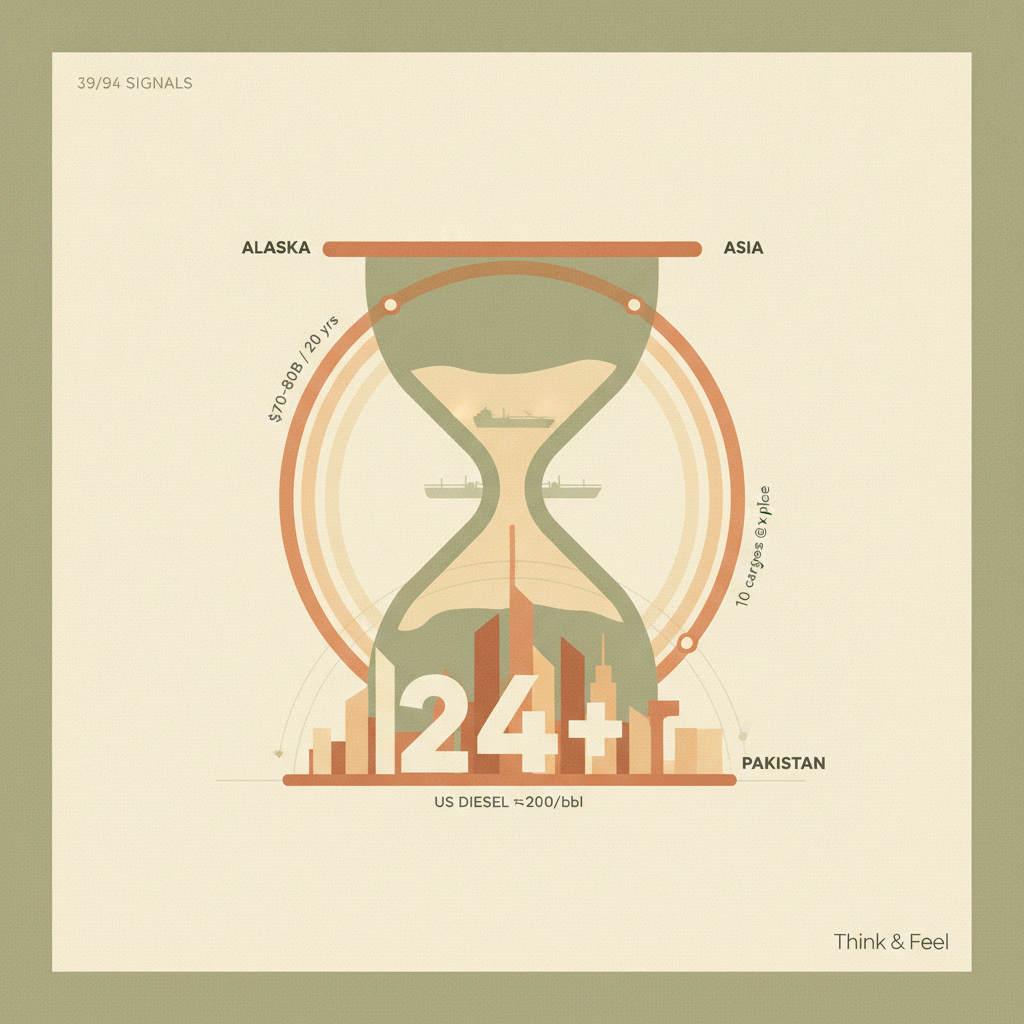
As missiles graze Dhahran and mines sink hulls off Hormuz, the Gulf's energy franchise is being repriced in real time — from Pakistani spot cargoes to Alaskan FEED decks.
The chokepoint is no longer a hypothetical — it is now a line item on every MENA operator's capex model, every Asian utility's hedge book, and every Washington policy memo.
This week, the Strait of Hormuz stopped being a backdrop and became the story itself. QatarEnergy's public admission that the Hormuz crisis now threatens the North Field expansion timeline (Gulf Business), coupled with Houthi missile damage to Saudi Aramco's Dhahran headquarters (OilPrice.com) and at least 24 commercial vessels struck in October alone, has shifted the Gulf's risk premium from episodic to structural. The downstream consequences — a Trump-announced $70–80 billion Taiwan LNG offtake from Alaska, Pakistani utilities paying double for spot cargoes, and a US invocation of the Defense Production Act — all trace back to the same vulnerable corridor.
Macro Layer
The macro picture is defined by a bifurcating LNG market and a reasserted geopolitical premium. European TTF strength has tilted arbitrage toward Asia (Gas to Power Journal), handing netback upside to QatarEnergy, ADNOC, and OQ — but only for cargoes that actually clear Hormuz. Pakistan LNG Limited's CEO confirmed at the WPC Energy Congress in Riyadh that term supply from Qatar remains force majeure'd since March, forcing Islamabad to procure ten spot cargoes at double the contract price (oilprice.com). Simultaneously, the US Treasury is pressing the World Bank to retire its 2019 upstream financing ban, a policy pivot that could unlock development capital for Iraq, Egypt, Libya, and Algeria — the second-tier MENA producers historically starved of multilateral upstream dollars. Layer in Ukraine's resumed strikes on Rosneft's Ryazan refinery, Novak's US-Russia diesel deal, and ULSD futures touching $200/bbl, and the picture is of a global products market so tight that Washington is reaching for Korean War-era statutes. Every one of these vectors raises the strategic value of GCC refining throughput — if it can safely transit.
Execution Layer
Execution-layer activity this week was dominated by capability-building rather than mega-awards, a telling signal in itself. SLB's partnership with Kuwait University to open a dedicated petroleum services laboratory (Kuwait Times) is the kind of ICV-aligned move that increasingly determines who wins the next KOC tender cycle — Saudization and Kuwaitization scorecards now travel upstream into the FEED and digital twin workstreams, not just the field headcount. With 94 signals clustered across Saudi Arabia (39), UAE (29), Qatar (29), Kuwait (26), and Oman (23), the geographic distribution confirms that execution capital is rotating within the GCC core rather than migrating outward. Notably absent this week: fresh EPCI mega-awards from Aramco's LTA roster or ADNOC's offshore program — a pause that likely reflects contractors reassessing war-risk insurance, crew mobilization, and marine spread availability in a Hormuz under active attack. Expect the next award wave to carry explicit geopolitical escalation clauses, and expect Chinese and Korean yards to price them more aggressively than European EPCs now constrained by sanctions-adjacent compliance regimes.
Company Moves
The company-level story is one of exposed concentration risk. QatarEnergy sits at the sharp end: nine signal mentions this week, almost all tied to North Field vulnerability. The contradiction is uncomfortable — Doha is simultaneously the lowest-cost LNG supplier in the world and the most geographically trapped, and buyers are now acting on that math. Taiwan's conditional $4.4 billion equity commitment to Glenfarne's Alaska LNG, alongside a 6 Mtpa offtake, is explicitly a Hormuz-avoidance trade (OilPrice.com), even at capex of roughly $2.7 billion per Mtpa — more than double US Gulf Coast benchmarks. Saudi Aramco, with nine mentions, is managing a different problem: physical strikes on its Dhahran complex reportedly damaged the top three floors used by senior executives, including the CEO's office. Operations continued from home — a quiet validation of the digital twin and remote-ops investments Aramco has made since 2019. Meanwhile ExxonMobil's decision to reinject 2 Bcf/d of Guyanese associated gas rather than monetize it as LNG (oilprice.com) removes a potential non-OPEC+ competitor from the LNG stack, marginally offsetting the Alaska threat to Qatari market share.
What to Watch
Three inflection points over the next fortnight. First, whether QatarEnergy publicly re-phases North Field Expansion milestones — any slip would reprice global LNG curves into 2028. Second, whether ADNOC or Aramco accelerate announced awards to signal operational continuity, or quietly defer to let insurance markets settle. Third, the World Bank's response to Treasury pressure on upstream financing — a reversal would reshape capital flows into Iraqi and North African gas within 18 months. Watch Kuwait's KOC for its next contractor framework announcement; the SLB laboratory move suggests a localization-weighted award logic is crystallizing.